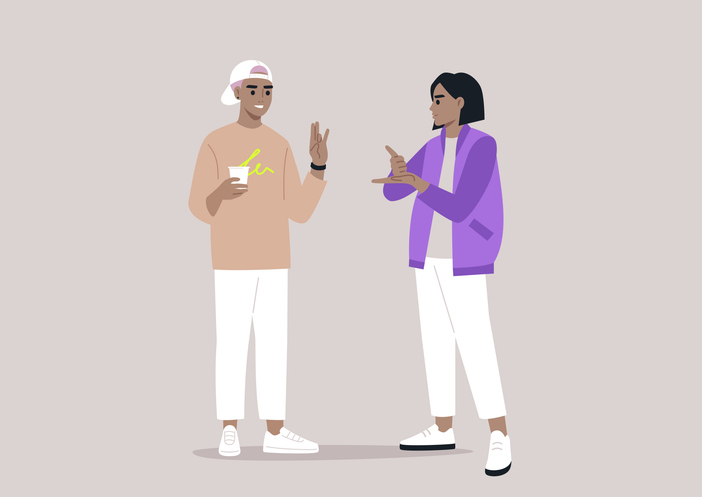
In September, we celebrate International Week of Deaf People 2025, a time dedicated to educating and spreading awareness about Deaf culture.
We asked Certified Rehabilitation Counselors (CRCs) affiliated with the Deaf community to share their knowledge and educate us. By centering these perspectives, we can begin to understand misconceptions and find more ways for inclusion for all deaf and hard-of-hearing folks.
What is Deaf Culture?
“I often compare Deaf Culture to a rich stew simmering in a pot—made of vegetables, herbs, spices, and bone marrow, each representing a vital element of Deaf Culture.” – Mallory Watts, CRC
The ingredients that create a vibrant and nourishing cultural identity within Deaf culture are essential to understanding it. Watts imagines the “vegetables” to represent the diversity of experiences of hearing loss across the spectrum. The “herbs” are the enriched history, including the evolution of communication, education, and technology. The “spices” are the creative contributions of the Deaf and hard-of-hearing communities. And the bone marrow reflects the foundation of individual identity, pride, language, and belonging.
When working to understand Deaf culture, it’s important to recognize that this disability is nothing to “fix”; it is its own identity with a language and a different way of experiencing the world. Rather than focusing on what Deaf individuals cannot do, we need to educate ourselves and spread awareness of the contributions they bring to their communities. Having respect is vital for building trust and supporting these individuals.
Understanding the Deaf Experience
“…when some are Deaf and have implants, the typical hearing person will assume that the Deaf person is no longer Deaf and hears what a typically hearing person hears, but they don’t understand that implants sometimes, at best, provide a distorted version of what the rest of us can hear.” – Jorge Navarro, CRC, CVE
There are many misunderstandings about Deaf experiences. For example, it is assumed that written or spoken English directly translates to signed English, but that is actually not true and can lead to mistranslations.
ASL communication is its own language with its own linguistic components capable of conveying complex ideas and emotions. Navarro notes that many individuals outside of Deaf Culture think of lipreading or implants as solutions that “solve” communication hurdles caused by deafness. In reality, lipreading only captures about 20-30% of spoken words.
Similarly, implants are not a perfect translation to normal hearing and can be distorted. These misconceptions can create barriers between individuals, which is why how you communicate is essential.
Recognizing communication barriers is vital to best supporting Deaf clients. It’s also important to remember the entire Deaf community cannot be boiled down to one experience.
What works well for one may not work for others; some rely on lipreading, some on writing, technology, or even interpreters. Being open about different communication methods will help foster a more inclusive and respectful environment.
Just like any culture, it’s also helpful to spend time with members of the community and learn from them. Engaging with the Deaf community is a very effective way to strengthen one’s understanding and ensure a proper interaction is had.
How to Promote Inclusion for the Deaf Community During International Week of Deaf People 2025 and Beyond
“So much hurt and offense happen at first appointments that many people who are Deaf or Hard of Hearing do not trust counselors enough to go back or continue to seek help.” – Summer Chappell Waldrip, MS, CRC, NAD-IV
Inclusion is about creating an environment where the deaf community feels supported. Miscommunication at an early stage can discourage one from seeking further support that they may need.
It may also evoke memories or feelings from past negative experiences caused by miscommunications or less inclusive individuals or systems, which in turn hinder trust-building.
One great habit to adopt during initial meetings is to ask each person their preferred communication method while also making sure there is accessibility in whatever environment you’re in.
As a Certified Rehabilitation Counselor (CRC), it is crucial to make sure that you make someone from the Deaf community as comfortable and safe as possible. Advocating for accommodations, trainings, and being mindful of differences, you can foster a sense of belonging when a person may feel like there is none.
Watts suggests that other strategies could include keeping a notepad around, learning basic ASL, and being flexible and patient. A great thing to remember, too: we are all eager to experience kindness and consideration. Kindness goes a long way; treating the Deaf community as equals is essential, just as you should be treating everyone else.
Frequently Asked Questions (FAQs) about Deaf Culture for International Week of Deaf People 2025
Kim Poage, MS, CRC, and Sheila Hoover, MA, CAGS, CRC, CVE, provided some frequently asked questions to help educate and spread awareness now and beyond International Week of Deaf People 2025.
Why does a hearing person who signs well not call themselves fluent in ASL?
As a hearing person, if I have not grown up with a Deaf parent or sibling, it would be disrespectful to those in the Deaf community to misrepresent myself as fluent in ASL. This is more than skill in the language and includes a lived experience as a part of the Deaf community itself.
I am learning sign language online from a hearing person. What do you recommend for me to supplement my learning?
Having an instructor who is a native signer is important in learning ASL. If that is not something available in your area, it’s encouraged to join communities virtually or in person that include native signers. Ask clearly when exploring Deaf community events if beginning students are welcomed, as they most often are, but not always, depending on the event.
Are there best practices out there for how VR works with the Deaf community?
Over the years, there has been a community of VR State Coordinators for the Deaf that have created the Model State Plan for VR Services for Deaf People, which can be found at https://www.csavr.org/deafmsp
Although it is always a work in progress, it is a recommended place to start for best practices developed by professionals, including members of the Deaf, DeafDisabled, DeafBlind, hard-of-hearing, and hearing community.
Where would you recommend I go to learn more about the Deaf community?
Two helpful places to visit include:
National Association for the Deaf (NAD)
National Deaf Center (NDC) Online learning (self-guided modules, webinars, Certificate Program, etc.)
Continuing to Better Understand Deaf Culture
International Week of Deaf People 2025 serves as a reminder that Deaf culture is defined by its identity, not by its limitations.
Continuing to educate and advocate is essential in fostering inclusion. By learning about misconceptions and adapting to one’s needs, an inclusive environment can be created for Deaf or hard-of-hearing individuals to feel supported.
Have a Topic You Want to Share Insight on for the CRCC Connect Blog?
Reach out to us at marketing@crccertification.com to tell us what you’d like to discuss about your research, work, or professional areas of expertise!
Recent Comments